Auto Parts Storefront Architecture
Project Overview
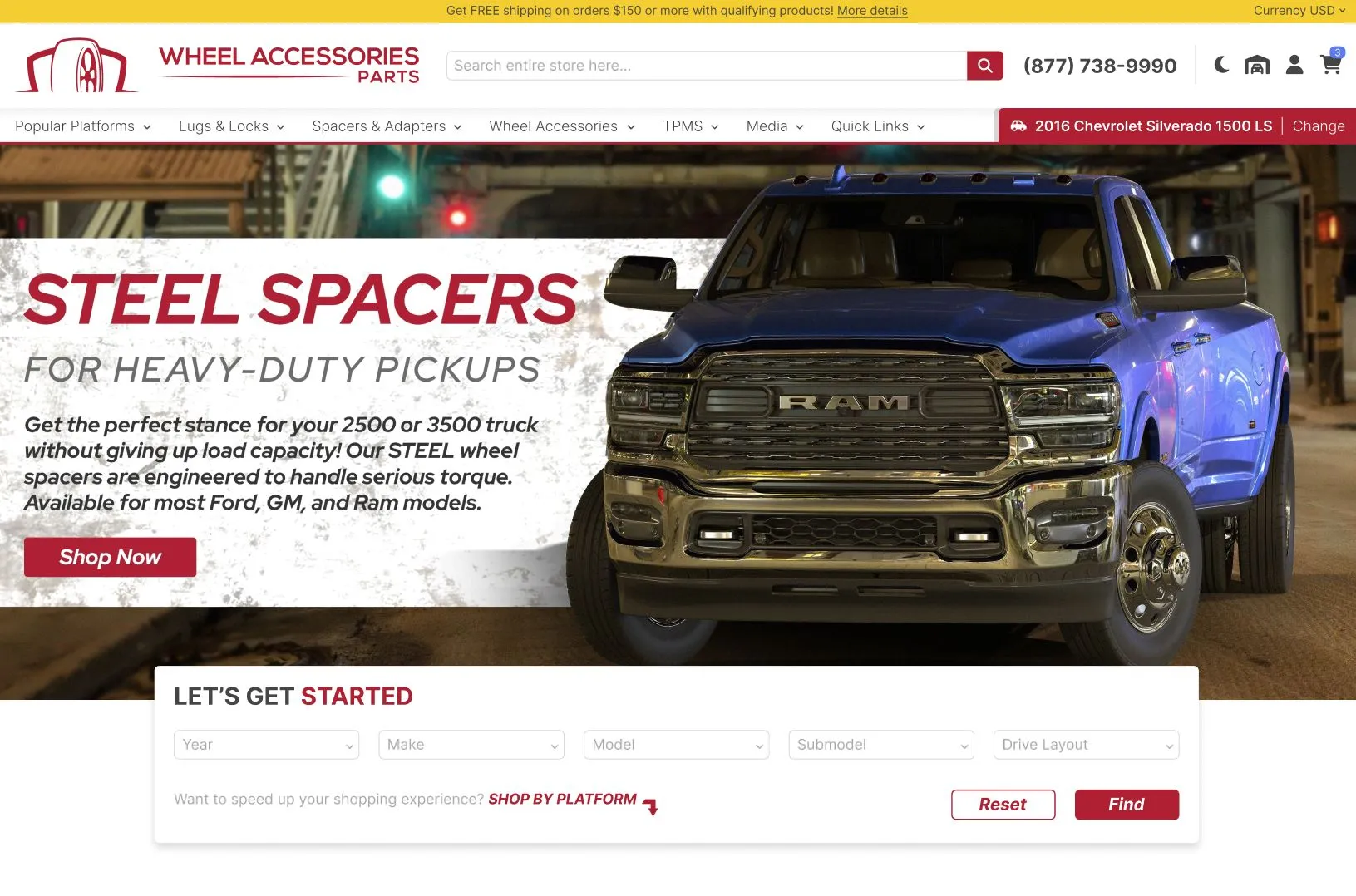
Rev Supply Co. built its business on marketplace performance, primarily on Amazon. Many customer journeys, however, originate in search engines. Capturing that demand with paid search ads and routing it directly to marketplace listings was an initial win; yet directing paid traffic to a fee-heavy third-party marketplace quickly hits diminishing returns. I proposed and structured the development of Rev Supply Co.’s first dedicated direct-to-consumer (D2C) e-commerce property to capture high-intent search traffic and convert shoppers on our own infrastructure.
Rerouting paid search acquisitions to our own storefront protects gross margins and provides complete ownership of the conversion funnel. This initiative preserved our Amazon footprint while establishing a disciplined capital allocation strategy: deploying ad spend to acquire lasting customer relationships rather than subsidizing competitive marketplace bidding wars.
I conceived the strategy, structural design, relational data models, API integrations, and UX architecture. This marked an intentional shift toward orchestrating end-to-end storefront architecture, directing engineering teams and external partners without writing the application code personally.
Objectives
- Architect the company’s first D2C e-commerce storefront
- Intercept search shoppers before they reach Amazon
- Streamline the customer journey through intuitive vehicle selection
- Scale merchandising via high-level automotive knowledge
- Build an extensible base for three existing child brands and future brand rollouts
Core Features
- Visual vehicle selector with dynamic image display via Evox API
- Platform-based navigation system with dynamic, tailored landing pages
- Enterprise-grade Magento 2 architecture built for multi-store expansion
- Integrated drop-shipping vendor fulfillment
The Platforms System
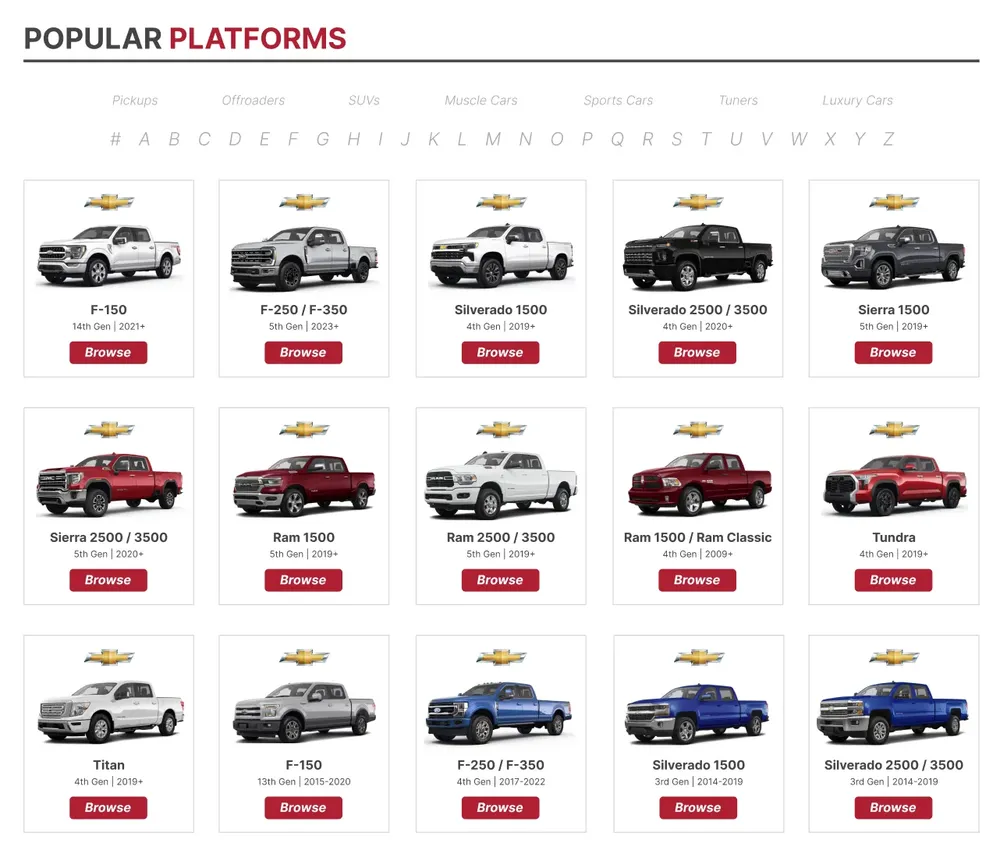
The platform system transforms catalog navigation. Beyond conventional year, make, and model dropdown cascades, users can browse by vehicle platform; a mechanically consistent group of vehicles manufactured across varying nameplates, brands, or generations. Providing platform-based entry points makes product discovery faster, intuitive, and engaging; shoppers recognize their vehicle visually and culturally rather than wrestling with automotive nomenclature.
System Logic
A “platform” designates a specific cohort of vehicles sharing identical mechanical architecture and interchangeable parts. A clear example is all 2017+ Jeep Wranglers (the Jeep JL platform). Many automotive naming conventions, however, are far more convoluted.
Consider Ram pickups from 2009 to 2018: all belong to the 4th-generation Ram lineage. From 2009 to 2010, they were marketed under the Dodge Ram nameplate; in 2011, Dodge branding was dropped. While the 5th-generation Ram debuted in 2019, Ram simultaneously offered the 1500 Classic; a brand-new vehicle built on the 4th-generation chassis. Consequently, the 2009–2010 Dodge Ram 1500, the 2011–2018 Ram 1500, and the 2019+ Ram 1500 Classic represent the identical physical chassis.
Another case in point: Toyota and Subaru co-developed a compact sports car in 2012. Subaru branded it the BRZ; Toyota designated it the GT86 across most international markets and the FT86 in others. In the United States, it debuted under the Scion marque as the FR-S, later transitioning to the Toyota 86 GT after Scion was phased out in 2016. Despite disparate year, make, and model taxonomy, the underlying mechanical footprint is identical.
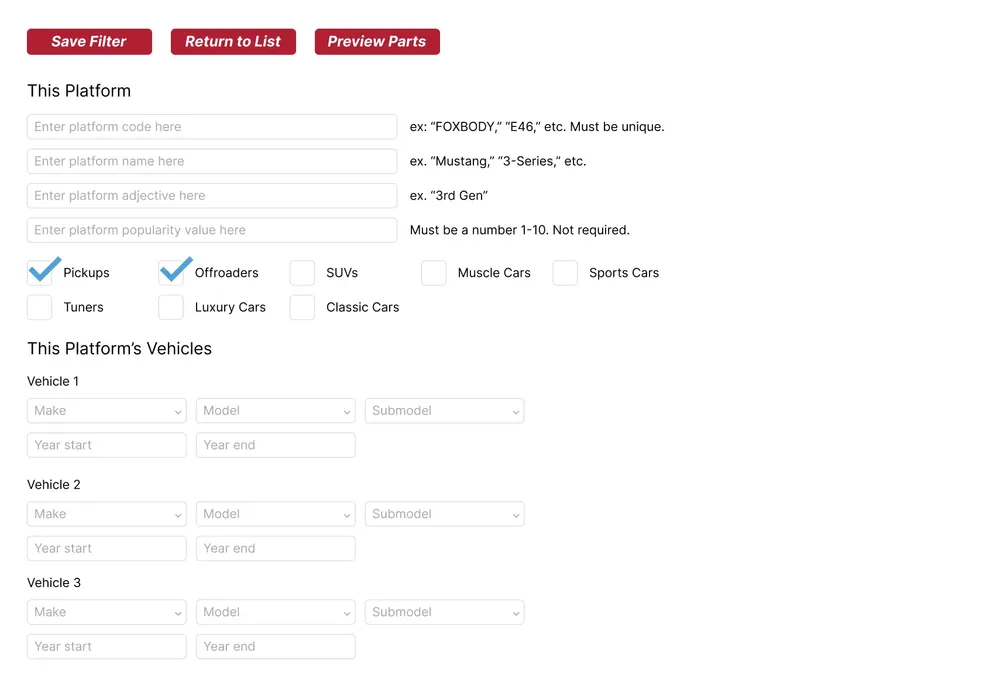
In the backend, each platform record carries a unique identifier and name (e.g., “E46”, “Mustang”), a descriptive qualifier (e.g., “3rd Gen”), and an assigned ubiquity score from 1 to 10 calibrated against United States DMV registration volumes and market prevalence. Multi-taxonomical category tags (such as PICKUPS, OFFROADERS, and SPORTSCARS) govern dynamic filtering; tags are non-exclusive, allowing vehicles like the Jeep Gladiator to index simultaneously across OFFROADER and PICKUP segments.
Each platform maps relationally to vehicle fitment tables via year, make, model, and submodel attributes. This structure clusters vehicles sharing mechanical lineage under unified catalog nodes. High-ubiquity platforms were indexed first, establishing a scalable taxonomy for continuous catalog expansion.
These associations bridge the structural shortcomings of standard cascading fitment filters. Resolving disparate marketing names into unified engineering platforms eliminates funnel friction and resonates with automotive enthusiasts.
Platform Landing Pages
Every platform maps to an autonomous landing page engineered for organic search relevance and conversion efficiency. Key elements include:
- Hand-tailored hero banners and promotional graphics
- Product grids dynamically filtered by platform compatibility
- Targeted promotional packages and contextual platform messaging
This structure speaks directly to specific enthusiast cohorts (such as 4th-generation Ram owners), reinforcing credibility through fitment precision.
Ubiquity-Aware Product Descriptions
The platform ubiquity attribute also drives dynamic copy generation based on verified on-road density. If a single hardware kit matches current Silverados, Tundras, Tahoes, and contemporary Camrys, along with an obscure legacy fitment like a 1987 Nissan 200SX, the Magento templating logic leverages the ubiquity score to omit low-volume edge cases when rendering condensed copy snippets. This programmatic hierarchy preserves clarity without requiring manual editorial maintenance across thousands of SKUs.
Visual Vehicle Selector
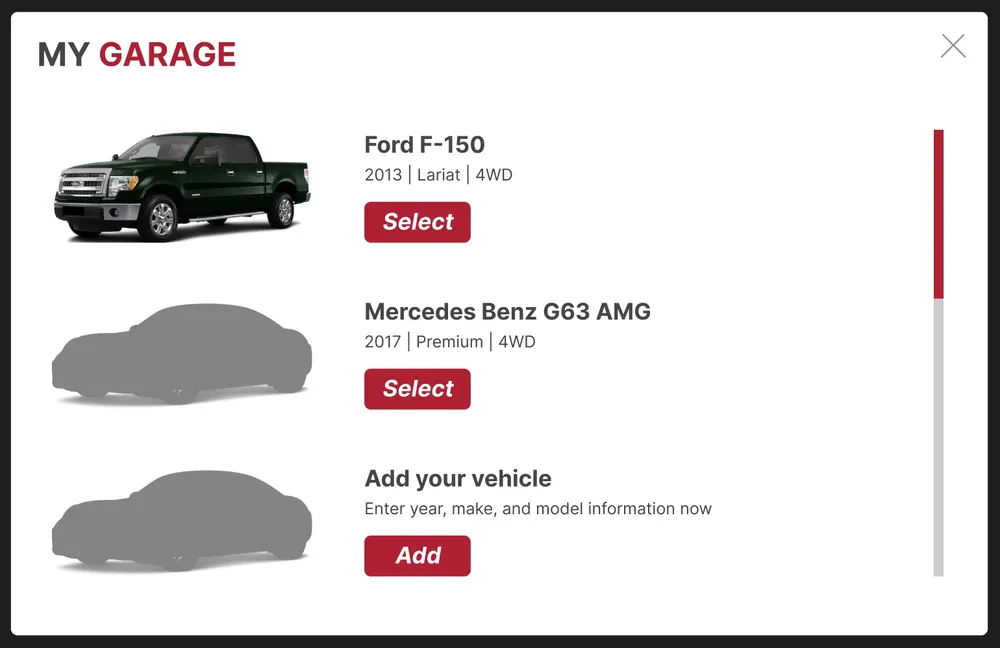
When a shopper chooses the traditional filter cascade, the experience remains visual. Selecting year, make, and model prompts real-time vehicle renders fetched via the Evox image API. Once selected, the vehicle commits to a persistent “garage” session state.
This visual feedback confirms fitment compatibility before checkout, minimizing buyer hesitation and returns.
Drop-Shipping Vendor Integration
I established drop-ship supply integrations to expand catalog depth beyond our physical warehouse footprint:
- Accelerating catalog coverage across high-demand categories
- Reducing inventory carry cost and working capital exposure
- Bundling comprehensive installation packages across high-ubiquity platforms
Drop-ship SKUs are flagged directly inside the product data pipeline and routed programmatically to fulfillment partners.
Magento and Brand Scalability
The application is architected on Magento 2 with a multi-tenant framework engineered to support Rev Supply Co.’s portfolio of brands. Coyote Accessories served as the inaugural launch instance; sister brands WAP and PDQ utilize identical data models, fitment logic, and backend infrastructure under custom brand themes.
User Study
To evaluate the platforms navigation model against standard automotive filters, I conducted a user study with 18 vehicle owners. Participants navigated part-discovery tasks across two configurations: a standard cascading dropdown filter and the integrated platform navigation system.
Findings (recorded via Hotjar session telemetry):
- 42% reduction in time to first product interaction
- 63% reduction in bounce rate
- Accelerated task completion among owners uncertain of specific trim levels or submodels
- Qualitative user feedback consistently cited rapid visual confirmation as the key differentiator
Product Status
The Hoboken architecture deployed to production at www.coyoteaccessories.com. I concluded my strategic leadership of the project prior to public brand rollout; the infrastructure initially served commercial B2B accounts as a verified ordering portal while consumer-facing catalog layers were staged for full commercial release.